Looking to Sell or Let?
Get started with a free property valuation today.
Property Valuation
"*" indicates required fields


If your ideal home is spacious, set in a large plot with a mature garden, then the quintessential village of Hinchley Wood should be on your radar. Situated between Esher and Surbiton, you might never guess at the easy access to London it provides.
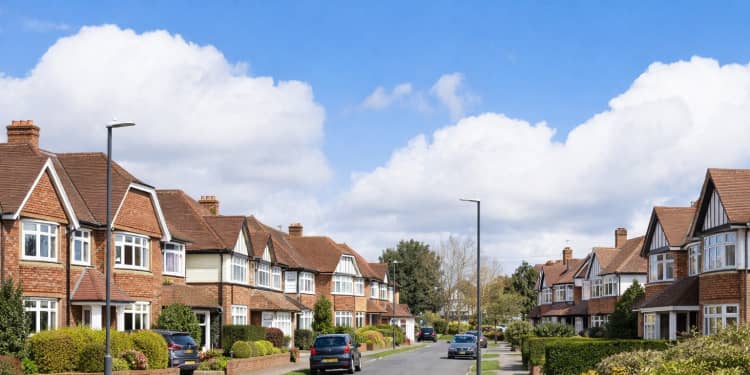
Its property landscape evolved around the station’s commuter services – and continues to draw both families and professionals looking for good schools, reliable transport, and houses with gardens in spacious plots.
Read on to learn about the most common home styles, sought-after architectural features, and market trends in Hinchley Wood.
Hinchley Wood is best known for its mainly 1930s and post-war housing, set along wide leafy avenues to meet demand for the then-newly built railway station. Architectural styles in this corner of Surrey tend to prioritise space, with a noticeable preference for semi-detached and detached layouts. The area’s tree-lined streets were carefully planned amid the era’s focus on bigger plots and easier car access, resulting in an open feel.
Bungalows, chalet bungalows, and two-storey houses with rendered or brick façades are common. Decorative details are generally restrained, but you are likely to spot bay windows, tiled roofs, and some half-timbered gables, especially in the older parts. Recent years have seen more redevelopment, but the area’s essential character remains rooted in comfortable, solidly built residences. Flat blocks exist but they are generally low-rise, and are rare in comparison to neighbouring towns.
While other property styles blend in at the fringes, the most common property types in Hinchley Wood are:
While the local property market also includes terraced houses,these are generally in the minority compared to the larger semi-detached and detached homes.
Hinchley Wood may not contain a designated Conservation Area itself, however, it’s set between several in adjoining areas including Thames Ditton and Esher. The Elmbridge Borough Council Conservation Areas offers further information on their boundaries, and the historic architecture of each.
Listed buildings within Hinchley Wood are limited, with the emphasis firmly on mid-20th century developments rather than Georgian or Victorian heritage. Neighbouring towns just beyond the village boundaries hold more Grade II listed buildings. That said, homeowners in Hinchley Wood must still consider local planning restrictions if they choose to extend or alter properties.
Despite the lack of formal heritage designation, properties with period features and mature landscaping play a major part in setting the area’s tone. Local planning policy, as set out by Elmbridge Borough Council, does seek to maintain the character of the area, especially with respect to building height and density.
Even in an area with as many tree-lined streets as Hinchley Wood, some are particularly sought after for their location, stand-out property sizes, and access to amenities:
These streets can achieve above-average prices for the area, thanks to their plot sizes and proximity to transport and schools.
In recent years, Hinchley Wood has seen steady levels of redevelopment rather than large-scale new build schemes. Most new homes are created through the demolition of older properties and replacement with one or two high-spec houses on the same plot. This trend has been common across Elmbridge, reflecting local planning policy to limit overdevelopment and maintain the highly prized suburban character.
Some infill developments have introduced modern townhouses and small blocks of flats, generally with private parking and communal gardens. For example, the retirement village on Manor Road South has brought new energy efficient, low maintenance homes to the area. Properties such as these tend to feature underfloor heating, open-plan layouts, and modern kitchens.
It’s important to note that while contemporary builds offer better insulation and low running costs, they tend to be fewer in number compared to the established housing stock. Buyers interested in new homes should watch for planning applications via the Elmbridge Planning Portal, or speak to a local estate agent as they may know of new developments coming soon.
With so many Hinchley Wood properties dating from the 1930s to 1950s, they can include a number of period features. Iconic details to look out when house-hunting for include:
Though less ornate than Victorian or Edwardian homes, these touches add sparks of interest and a real sense of history. Period features tend to add value, especially when well-preserved and combined with sympathetic modern updates.
Homes in Hinchley Wood are larger than the national average – no surprise to those familiar with its spacious plots and imposing detached homes. Data from the Office for National Statistics (ONS) shows that the average floor area for detached properties in Elmbridge is over 140m², while the average for semi-detached homes is about 110m².
Here’s a breakdown of typical sizes:
| Property Type | Average Bedrooms | Approx. Floor Area (m²) |
|---|---|---|
| Detached House | 4–5 | 140–200 |
| Semi-Detached House | 3–4 | 100–140 |
| Bungalow | 2–3 | 70–120 |
| Flat/Maisonette | 1–2 | 50–80 |
Garden sizes also tend to be generous, often ranging from 50 to well over 100 feet in length for family homes. This supports outdoor activities and scope for extensions, which are popular in the area. That additional indoor and outdoor space can prove particularly tempting if you are relocating from London.
One major draw of Hinchley Wood property is the ample outdoor space for children to run free, adults to relax on long summer evenings or simply the seclusion it brings. Most homes come with front and back gardens, adding to the area’s appeal for families and those who value privacy.
The spacious gardens attached to so many Hinchley Wood properties can often give scope for home improvement projects, such as rear extensions, garden offices, and landscaped patios. These have the potential to further increase a property’s long-term value, not to mention adding comfort and convenience while living there.
A: As per Rightmove data for February 2026, average sale prices in Hinchley Wood stand at approximately £875,000 across all properties, with detached homes fetching upwards of £1.1 million and semis commonly reaching £1 million or more.
A: Yes, Hinchley Wood School and several primary schools in the area have high Ofsted ratings, and there are many high-achieving independent schools in easy reach.
A: Hinchley Wood railway station offers direct trains to London Waterloo in under 40 minutes via South Western Railway. The A3 is easily accessible for motorists, and local bus routes serve Esher, Surbiton, and Kingston.
A: With fewer listed buildings and no conservation area status, extensions are generally easier to arrange than in more protected zones, provided they meet Elmbridge Borough Council’s planning guidelines.
A: Rental properties are in demand, particularly family houses and two-bedroom flats, which are rare locally. Average rents range from £1,400 for a flat to over £6,000 for a detached house, as demonstrated on Zoopla.
Hinchley Wood offers a respectable range of 1930s and post-war homes, with large gardens and practical layouts. Whether you are searching for a family home, a downsizer’s bungalow or apartment, or a modern new build, the area has plenty of options to explore. Local schools, regular transport links, and mature outdoor spaces of all sizes make this Surrey neighbourhood a sound choice for many buyers and renters. Local knowledge can be valuable in connecting you with the ideal property, so don’t hesitate to ask.
For tailored advice or help with buying, selling, or letting in Hinchley Wood, contact Davies Property Partners today – we have recently relaunched our local office in the area after serving Hinchley Wood since 2003.
Get started with a free property valuation today.
"*" indicates required fields
If so, contact our friendly team today.
"*" indicates required fields

Thames Ditton looks deceptively straightforward on a map - but two nearly identical streets can differ by hundreds of thousands of pounds...

Twelve miles from central London, with trains into Waterloo in under 30 minutes, a charming riverside village centre, and property prices...

Thames Ditton looks like a quiet Surrey village — until you start looking at the houses. Within a few streets, you'll find Georgian river...