Looking to Sell or Let?
Get started with a free property valuation today.
Property Valuation
"*" indicates required fields


Considering a move to Thames Ditton, and wondering what homes you’ll find there?
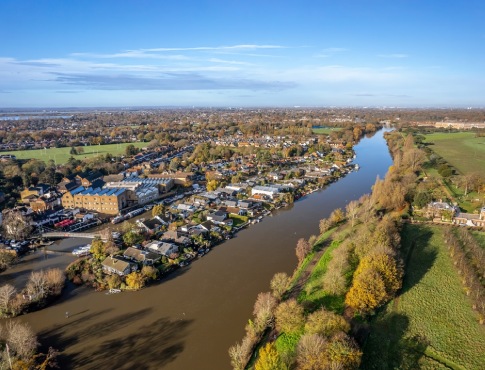
Buyers coming to Thames Ditton will find tightly packed Victorian terraces, wide-fronted Edwardian semis and Georgian riverside cottages that they expect from the leafy Surrey village.
In short, there’s an abundance of high-quality family homes that many people appreciate. So, why not explore our concise guide to local property. You’ll learn what homes occupy the area and the pros and cons of each one depending on your aims.

What makes Thames Ditton distinctive, compared to neighbouring Esher or East Molesey, is the way the older homes site right in the historic village centre.
The winding High Street, the proximity of the River Thames, and the survival of features like the 13th Century Church of St Nicholas give the area a degree of architectural coherence that sets it apart. Of course, that leads to anothe rconsideration for buyers.
A significant portion of the most sought-after streets fall within the Thames Ditton Conservation Area, and what you can do to a property here is more constrained than in unconstrained parts of the borough.
Thames Ditton’s housing styles span several distinct periods – and the type of property you’re targeting will shape both your budget and your survey priorities. The table below sets out the main categories you’ll find as you look around the Thames Ditton property market.
borough:
| Property type | Typical period | Typical tenure | Approximate price range (2026) |
|---|---|---|---|
| Victorian terraced house | 1860s–1900 | Freehold | £680,000–£900,000 |
| Edwardian semi-detached | 1900–1915 | Freehold | £850,000–£1.2m |
| Georgian / early Victorian cottage | Pre-1860 | Freehold | £750,000–£1.3m+ |
| Inter-war detached | 1920s–1930s | Freehold | £1.1m–£1.6m+ |
| Purpose-built flat | 1960s–1980s | Leasehold | £320,000–£520,000 |
| Converted flat | Victorian / Edwardian | Leasehold | £380,000–£580,000 |
| New build / recent conversion | 2000s–present | Freehold / Leasehold | Varies |
The largest single category by volume, found along and around the High Street, in the streets running towards the station, and in the older areas towards the A309.
Thames Ditton’s Victorian terraces tend to be two-storey, bay-fronted or flat-fronted, built in London stock brick, and narrower than their Edwardian successors. Many have been extended to the rear, though their original footprints are modest by today’s standards. Thanks to their proximity of the conservation area, many of these elegant homes retain original sash windows and other charming details.
Edwardian semis are well represented in the streets further from the historic village centre, where the land released for development around the turn of the 20th Century allowed for wider plots and larger room proportions.
These properties typically offer larger rear gardens than the Victorian stock, more generous ceiling heights, and, in the better-preserved examples, original tile paths, stained glass fanlights, and decorative timber bargeboarding.
A smaller but notable category, concentrated close to the river and around the church. Several of these properties are individually listed or sit within the most tightly controlled part of the conservation area. They offer plenty of historic character, but naturally come with the most demanding maintenance obligations of any property type in the village.
The 1920s and 1930s left a belt of larger detached houses on the outer edges of the village, particularly towards Weston Green. These properties offer the most generous plot sizes in Thames Ditton and are typically freehold, with the added feature of off-street parking. Architectural quality varies, though the best examples have retained original Crittall windows and decorative brickwork. Others have been substantially altered.
Purpose-built flats from the 1960s to 1980s can be found in small blocks, primarily leasehold, and represent the most accessible entry point by price. Converted flats carved from Victorian and Edwardian houses are also available; these tend to offer better proportions and character than the purpose-built stock but require careful lease and service charge scrutiny before purchase.
The Thames Ditton Conservation Area was designated by Surrey County Council on 31 July 1973 and subsequently extended in 1987 and 2009. It covers the historic village heart, centred around the High Street and the area around the Church of St Nicholas, extending towards the river.
Key planning implications for buyers within the conservation area:
Listed buildings of note:
Buyers purchasing within or immediately adjacent to the conservation area should request the full conservation area appraisal from Elmbridge Borough Council’s planning department before exchanging. It’s important to check as there are specific character elements that the council will seek to protect, and only certain alterations are likely to be approved.
Want to know more? Discover the best streets in Thames Ditton for a home, and read our guide to living in Thames Ditton.
In Thames Ditton, the Victorian terraces closest to the High Street and conservation area boundary have the highest rate of original window retention, partly because past generations of owners were advised or required to maintain them. Further from the core, modification rates are higher.
Edwardian semis in Thames Ditton have been popular with buyers extending upward into loft space; permitted development allowances apply in unconstrained properties, but conservation area restrictions apply where relevant.
Thames Ditton is known as a new-build market. It’s largely built out, and the conservation area designation limits the type and scale of development that Elmbridge Borough Council will approve on most central sites. For buyers specifically seeking new-build stock, neighbouring Esher and Walton-on-Thames offer more options.
Recently, modern apartment buildings and office units were constructed on the former AC car works site, and this is the kind of redevelopment that Thames Ditton sees. Aldi has submitted a planning application for the former Guy Salmon site, with a view to bringing a new store to the area.
Outside space in Thames Ditton varies considerably by property type, which means buyers should be clear about what they need before committing to a type.
Period property in Thames Ditton is often Victorian or Edwardian with solid wall construction, which presents a different set of risks than cavity-wall houses built after the 1930s. It’s best to commission a full RICS Level 3 Building Survey (formerly HomeBuyer Report) for any pre-war property. A Level 2 is unlikely to provide sufficient detail on the issues most likely to affect these buildings.
Key issues to investigate:
A full RICS Level 3 Building Survey is the appropriate starting point for any pre-war property in Thames Ditton. For listed buildings, consider engaging a surveyor with specific experience in historic building fabric.
Thames Ditton’s property market rewards buyers who know what they’re looking at, whether that’s a well-preserved Edwardian semi, a riverside cottage, or a flat positioned for the station commute. If you’re at the research stage or ready to move, register as a buyer with Davies Property Partners, search property directly on our website, or contact us to talk through what’s available and what to look for.
Victorian terraced houses make up the largest share of the housing stock, and are mostly concentrated around the High Street and the streets near the station. Edwardian semis are well represented further from the centre, with inter-war detached houses toward Weston Green. Purpose-built and converted flats are present but form a smaller share of the total stock.
Yes. The Thames Ditton Conservation Area was first designated in 1973 and has been extended twice since, most recently in 2009. It covers the historic village core around the High Street and Church of St Nicholas, and properties within it have fewer permitted development rights.
Houses in Thames Ditton are almost universally freehold. Flats, whether they’re purpose-built or converted from larger houses, are typically leasehold. If you do buy a leasehold property, you should check the unexpired lease term, as well as the ground rent structure and service charge details as the costs can be higher than you expect.
The most important things to check include damp in solid wall construction, the condition of original drainage runs, the condition of chimney stacks, and any flat roof extensions. Electrical systems in unmodernised properties should also be assessed separately, with an electrical installation condition report. A RICS Level 3 Building Survey is strongly recommended when buying any older homes.
Very few. Thames Ditton’s conservation area designation limits the scope for larger-scale new development in the village centre, but nearby areas offer more of a mix. Buyers specifically seeking new-builds will find more options in neighbouring Esher or Walton-on-Thames.
Get started with a free property valuation today.
"*" indicates required fields
If so, contact our friendly team today.
"*" indicates required fields

Thames Ditton looks deceptively straightforward on a map - but two nearly identical streets can differ by hundreds of thousands of pounds...

Twelve miles from central London, with trains into Waterloo in under 30 minutes, a charming riverside village centre, and property prices...

Fourteen miles from central London, Esher offers something increasingly rare: genuine green space, fast trains to Waterloo, strong school...